
I first heard Makoto Fujimura in an interview on an episode of the podcast “In the Studio with Michael Card” several years ago. In the interview Fujimura shared how his faith helped shape the philosophy behind his art after his conversion to Christianity. (Here is a link to his website...please check it out!) I was impressed that he had developed a well articulated theology of creativity and was actively seeking to live out this theology to influence the art world as a whole. After I discovered that he had written several books outlining his theology of creativity, I put them on my ever-growing wishlist of books (somehow my actual reading never keeps up with my desire to read) and eventually got around to purchasing a copy of his book Culture Care. In this book Fujimura draws inspiration from the creation care and soul care movements to expound the theology and philosophy behind a movement that seeks to empower artists to confront the divisive culture war mindset, call out our toxic focus on a utilitarian individualistic lifestyle, and contribute to a rebuilding of the common good.
What is culture care?
Fujimura strives throughout the book to inspire us to see culture in a new way; “Culture is not a territory to be won or lost, but a resource we are called to steward with care. Culture is a garden to be cultivated.” Cultivating this garden is the goal of the culture care movement that Fujimura seeks to inspire. Culture care at its heart is focused on what Fujimura describes as generative principles. Generative principles such as stewardship and generosity are principles that allow for the creation or growth of something that “over time, recognizes, produces, or catalyzes more beauty, goodness, and flourishing.” Key to this is having a developed theology of beauty. Fujimura writes, “As an artist and a Christian, I find the source and goal of beauty, of generative thinking, and of responsible action in the biblical understanding of what our lives are for. We find our creative identity in God. Generative moments can be assumed because God is the Great Artist, and we are God’s artists, called to steward the creation entrusted to our care.”
Challenges to Culture Care
Fujimura next elaborates on the challenges that face those trying to fulfill the mandate to steward the garden of culture, namely cultural pollution that stunts the growth of a rich life giving culture. He pinpoints the successes of the Industrial Revolution as creating a society in which “success for a large part of our culture is now judged by efficient production and mass consumption. We often value repetitive, machine-like performance as critical to bottom line success.” A culture focused on productivity and efficiency has little ability to see the fullness of humanity.
A related issue arises from development of ‘experts’ who are highly specialized and isolated in their disciplines, adding to the problem of cultural fragmentation. Questions of meaning often fall through the cracks of an intellectual framework of experts all of whom are isolated from other areas of expertise. Fujimura sees cultural stewardship of beauty as a way to counter these poisons in our cultural soil noting, “Cultural fragmentation comes rather when we treat survival as the bottom line and thus neglect the wholistic approaches that demand personal growth and point our civilization toward a greater vision. Fragmentation comes when we forget the importance of beauty in our lives and the necessity – for both individual and social flourishing – of sharing the experience of beauty in community.”
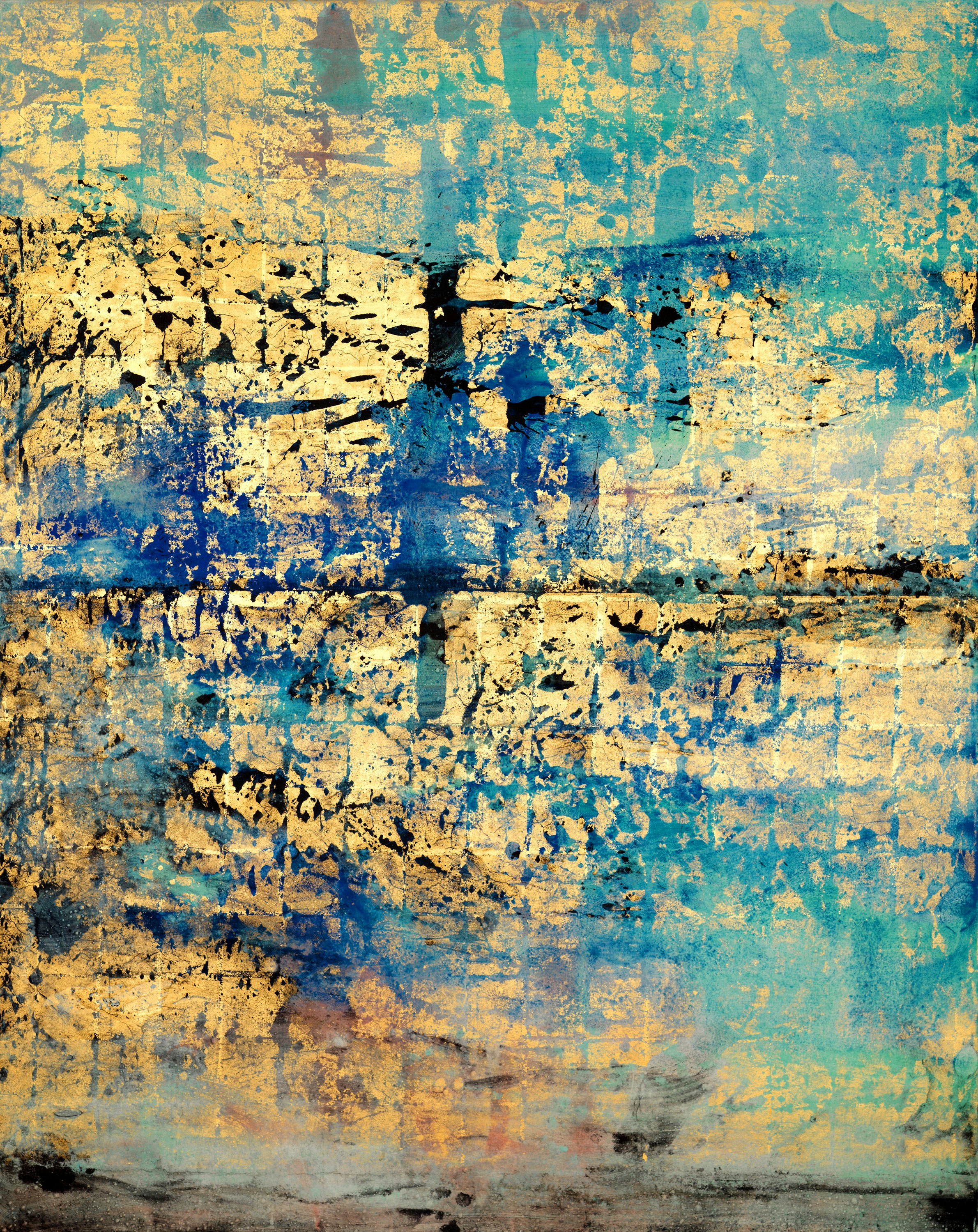
Golden Sea
Mineral Pigments and Gold on Kumohada, 80×64″, 2011 by Makoto Fujimura, Collection of Roberta and Howard Ahmanson
The third challenge to culture care is the fact American society has been, for quite some time, locked in what has been deemed by many ‘the culture wars’. Fujimura observes, “Too many of us live isolated – sometimes more literally, sometimes virtually – with the tribes on our own cultural islands. We have no meaningful engagement with or understanding of the humans across the divide. Few people are willing or able to build bridges. When we are living in a mode of survival and scarcity rather than generativity, we easily fall into viewing those outside as enemies locked in utter competition for commodities or power that should be ours.” The result of all of this cultural division is that people are no longer working towards the common good, a state of affairs that is ultimately unsustainable for a society.
Artists as Agents of Cultural Healing
At this point Fujimura begins to lay out his vision of how artists can bring these ideas of cultural stewardship and generativity to bear in our tainted and splintered society. He uses an image drawn from the Old English word in the epic poem Beowulf: mearcstapas. Translated into modern English it means border-walker or border-stalker, essentially someone who lives on the borders of different groups and who thus has been placed into a position that allows them to more freely interact with ‘outsiders’ than those who are further from the borders. Fujimura then translates this image into our modern culture wars, and imagines the artist as being a border-stalker who can navigate spaces in between the the different cultural factions, using beauty as a means to bring hope and reconciliation.
Throughout the rest of the book Fujimura develops these ideas further; encouraging churches to identify and develop artists to be border-stalkers, discussing how art helps to combat degrading utilitarian impulses in our culture, and drawing on the environmental analogy of a ‘cultural estuary’ to describe what Fujimura believes to be an ideal environment for the growth a culture care mindset. He also manages to pack advice on adapting a culture care mindset to the business community and offers some practical advice to aspiring artists into the 150 odd pages of this rich book. I first read this book a year and a half ago, and after I decided to write a review on it, I re-read the book and discovered it to be even deeper and more thought-provoking the second time around. It is a book that will wear well over time, and I suspect its impact will be much greater than many far more popular books.
My Thoughts on ‘Culture Care’
Though I am science teacher and not an artist, I found much of value in this book. It is not a coincidence that Fujimura draws on analogies from nature to illustrate his points. Those who are advocating for environmental stewardship will find that many of the arguments Fujimura uses to advocate for the place of art in society also are powerful arguments in favor of valuing the environment in our lives. After reading this book, I would argue that ‘Culture Care’ and ‘Creation Care’ are in fact two different expressions of the same mindset; both attempting to reflect a more complete biblical theology (and thereby a fuller reflection of the nature of God) into an increasing impoverished social discussion.
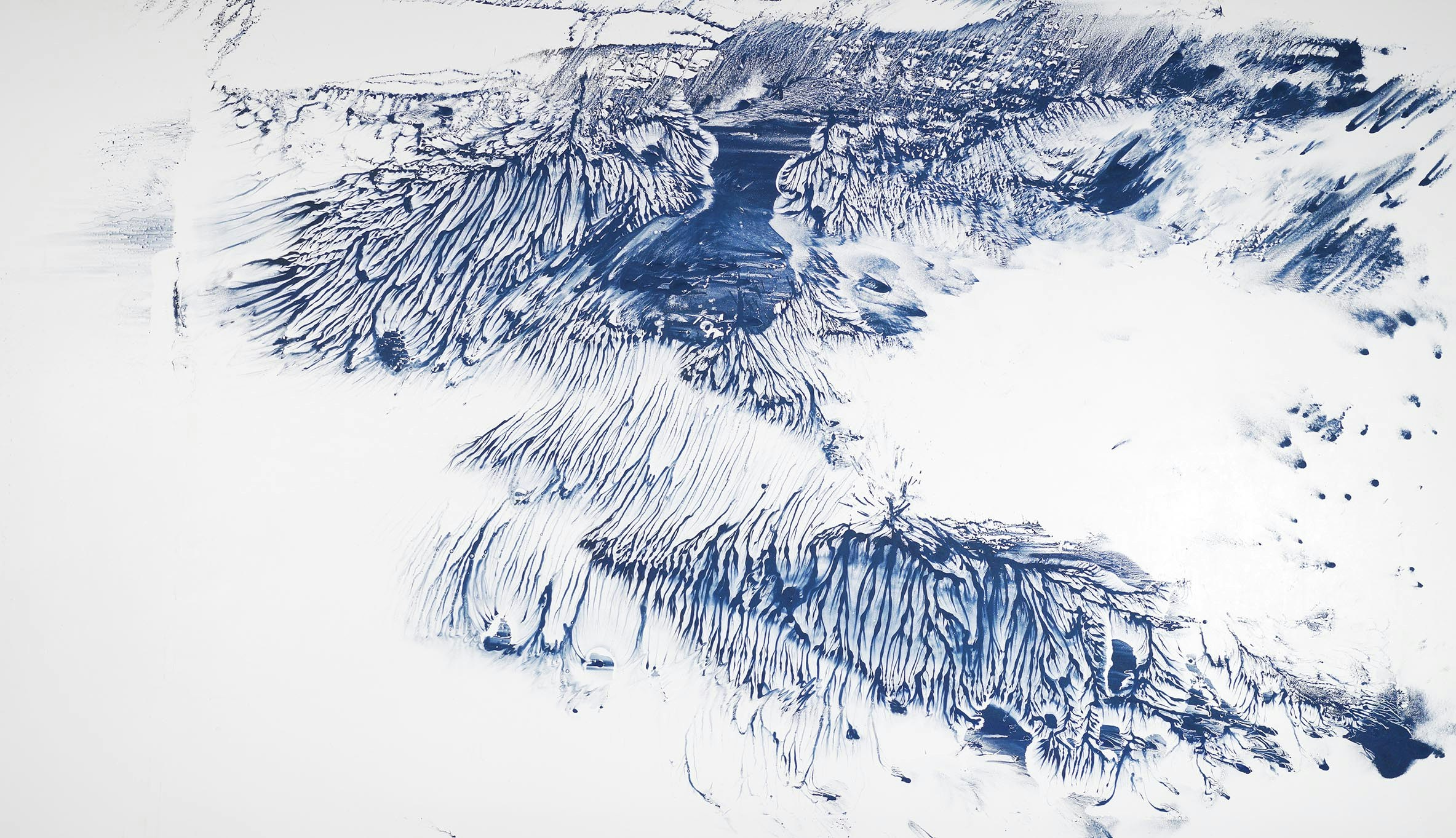
“Walking on Water – Azurite II”, Copyright © 2016 Makoto Fujimura, Mineral Pigments on Polished Gesso on Canvas, 84 x 132 in.
I find myself resonating deeply with Fujimura’s description of our current cultural situation, and found his offering of a theology of beauty to be both enriching and encouraging. Enriching because as a non-artist I gained a good deal of appreciation for the role of art in society; encouraging in the way a distant light can provide hope when you are wandering, seemingly alone, in the darkness. Culture Care shines the light on the necessity of beauty for those wandering through the darkness of an American society that seems determined to self-destruct. Beauty is not a add on to life that we can enjoy we everything else is taken care of, but an essential reflection of a creative God who imparted beauty into his creation and gave us the responsibility to recognize and cultivate it.
Last, I found that Fujimura’s concept of the artistic border-stalker to be illuminating, and I think that this idea extends far beyond the artistic community. As an orthodox, evangelical Christian and a science teacher there are a number of ways I feel that I am living in border lands between various social ‘tribes’, whether it is on issues such as evolution or environmental stewardship. Throw in the chaos and challenges of politics in the U.S today, and I feel very much like a border-stalker who is perpetually on the boundaries. Fujimura’s use of this analogy has encouraged me to think of this as a positive identity that can be used to help various groups understand each other, rather than simply dwell on the social isolation that can come with not feeling at home with any particular faction in current American society.
As you probably have gleaned from this review, I found Culture Care to be an excellent book that I would highly recommend to anyone inclined to take time to really think over the condition of our culture and it’s direction. While addressed specifically to artists, I think many others would appreciate and benefit from the insights in Culture Care.
Thanks for reading. Please leave a comment below or on Facebook . You can sign up below if you wish to have new posts emailed to you, or you can follow by ‘Liking’ the Facebook page.
If you are interested in purchasing a copy for yourselves, below are links you can use.

Culture Care: Reconnecting with Beauty for Our Common Life
By Makoto Fujimura / InterVarsity Press
Many bemoan the decay of culture. But we all have a responsibility to care for culture, to nurture it in ways that help people thrive. In Culture Care artist Makoto Fujimura issues a call to cultural stewardship, in which we become generative and feed our culture’s soul with beauty, creativity, and generosity. We serve others as cultural custodians of the future. Includes a study guide for individual reflection or group discussion.
Discover more from On Earth as it is in Heaven
Subscribe to get the latest posts sent to your email.

 On Earth as it is in Heaven